
Previous Events
KILOF Conference 2026 - What AI can do and how it can be used for effective teaching

Does the use of AI inevitably lead to “deskilling,” that is, the phenomenon of “unlearning”? Does AI slow down the growth of skills and make it impossible to verify? Or is this just doom-mongering that fails to recognize the potential for higher education? The field finds itself somewhere between prompt, presence, and stalemate: What still matters in higher education? What should students be able to do afterward? What, then, constitutes meaningful assessment? Perspectives on this topic will be discussed in Bern on May 1.
AI & Law Lecture Series: From Formalism to Relational Accountability in Complex Computing Environments
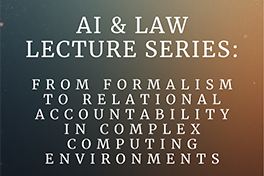
The guest lecture by Bilge Kaan Güner (Lawyer, Consultant and Doctoral Researcher at the University of Tübingen, Faculty at Law) examines the limits of formal legal responsibility under the GDPR when technology producers shape data protection by design (DPbD) without being directly regulated as controllers or processors.
Department of Digital Medicine Opening Event
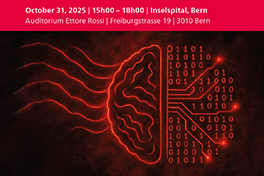
We are delighted to have launched the Department of Digital Medicine (DDM) with a public opening event that brought together esteemed experts and thought leaders to explore the transformative potential of digital medicine within contemporary healthcare systems.
- Date: October 31, 2025 from 3-6 p.m.
- Location: Auditorium Ettore Rossi | Freiburgstrasse 19 | 3010 Bern
- Moderation by Eliane Leiser, SRF
Experts in malfunctioning? A history of technological errors and the question of “error literacy.”
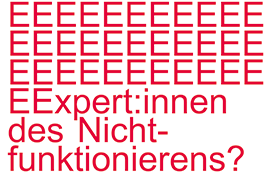
Lecture of Martina Heßler, TU Darmstadt
A few years ago, media scholar Lisa Nakamura stated that when it comes to using digital devices, we have all become “experts in malfunctioning.” This lecture took up this observation and asked how we deal with digital errors and AI errors. Based on the thesis that we have been entering a new era of technological errors since around the 1970s, it was argued that this has less to do with error literacy or expertise in matters of error and more to do with new forms of ignorance and incomprehension. This was illustrated with examples, focusing on both technology developers and users.
- WWWWednesday, 15.10.2025
- Organisation: Anna Baumann, Leo Grob
First BeLEARN Conference on September 4, 2025

Translation 2025
Whether school, university or vocational education: As digitalization progresses, more and more complex questions are arising in educational practice. This is why BeLEARN, the national competence center for digital change in education, initiated a solution-oriented exchange: “Translation 2025” was the first conference to bring together research, business and educational practice. It offered the opportunity to learn about successful examples from research and practice and to network.
3rd workshop of the DigiK focus group Extended Reality
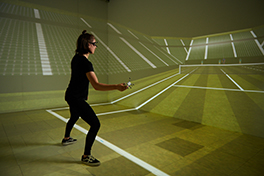
Perceptual psychology: mental imagery, sensorimotor processing, and visual perception
The third workshop took place on June 6, 2025, from 1 p.m. at the Department of Psychology of the Faculty of Humanities. The program featured two exciting talks on XR technologies: Babette Bühler presented how eye tracking can be used in immersive learning environments to detect cognitive states and provide adaptive learning support. Benjamin Schöne explored how virtual reality can enhance the ecological validity of psychological experiments, offering new insights into attention, memory, and social perception. The workshop also included an introduction to the local research infrastructure.
6th Swiss Congress of Telemedicine and Digital Health

Digital Medicine and Artificial Intelligence: a Reality Check
Our congress “Digital Medicine and Artificial Intelligence: a Reality Check” offered a practical stocktaking. Experts from medicine, research, and industry shared their experiences with the application of digital and AI-based technologies. In addition to innovative solutions and success stories, the focus was also on stumbling blocks, misdevelopments, and unexpected problems that accompany the path toward the digital future of medicine. In interactive lectures, we addressed questions from practice for practice: How is AI changing medical decision-making? Are digital assistance systems a relief or, in fact, a burden? How can new technologies be successfully integrated into existing care structures?
more information (PDF, 773KB)Digital In/Justice Networking Event

Networking Event
An interactive social event to spark discussion around critically engaging with the social, cultural, economic and political dimensions of digitalization. With numerous activities including professional speed dating the aim was to connect people of all career stages who work on similar topics over light snacks.
Digital In/Justice and Data Feminism

Emilie Jäger Lecture
Prof. Dr. Catherine D’Ignazio (MIT) discussed what we can learn from feminist collectives’ efforts to document feminicides and how data activism focusing on care and restoration can show transformative ways towards data justice.
KILOF ConferenceTagung 2025 - Artificial intelligence in Administration

The KILOF Conference 2025 was dedicated to the use of artificial intelligence in administrative processes and highlighted the associated opportunities and challenges. Experts from science and practice provided insights into current projects and developments and opened up new perspectives on the use of artificial intelligence within administration.
The Future? Education and Regulation
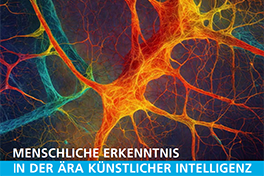
Since the launch of Chat GPT in September 2022, artificial intelligence (AI) has reached a wide audience. However, the exact way it works often remains unclear and questions arise such as: Who is responsible in the event of damage? Is our data secure? Can AI systems be regulated? In the last event of the four-part series, the Forum for University and Society was asking about regulation and the future significance of knowledge.
13th Day of Teaching “Assessment Impossible? Proof of competence and artificial intelligence”
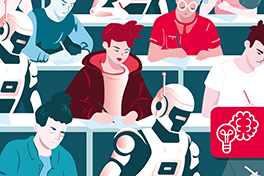
Conducting examinations in the age of AI poses new challenges for universities. How should proof of competence be designed in the age of AI? On the 13th Teaching Day at the University of Bern, we took stock of the current situation and looked for answers to the question of how competence-oriented assessment can be carried out with and despite AI.
Advancing academic engagement with AI standardisation: Generating research impact through standards development

Engaging with AI standards development offers a unique and underutilised avenue for academics to translate their research into tangible impact. At the same time, insights gained through previous AI Standards Hub events suggest that there are fundamental challenges for academics to contribute. These involve a historical lack of awareness of the standardisation ecosystem, limited knowledge of how to contribute in concrete terms and the need for dedicated training and incentives specifically for academics to meaningfully engage. To further unpack these challenges and to work towards forming solutions, this event convened academics from different geographic regions for a deep dive discussion into the relevance and practical implications of their research contributing towards standards development.
Artificial Intelligence for Natural Health?
The Forum for University and Society aims to provide guidance through its series of events. It used examples to illustrate how AI works and how it is already influencing our everyday lives. It highlighted the opportunities and possibilities as well as the ethical and legal challenges that need to be addressed now. The aim was to develop a deeper understanding of AI and to raise awareness of the associated problems.
2024
31.10.2024 - Event - Events on critical perspectives on digitalization
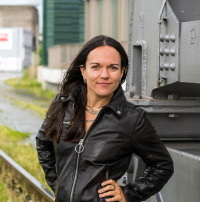
#12 On large publishers, AI corporations and the perils of third-party funding: how science is chaining itself
Science is free - one might think at first glance, and that would certainly be desirable. In fact, however, science has repeatedly found itself in problematic dependencies in recent decades. These include dependence on large publishers, which the open access movement is only partially able to resolve, dependence on third-party funding for research as well as reputation, and, more recently, an increasing dependence on commercial AI tools. The keynote address will explore these dependencies and show how they can be broken.
The End of Humanity - Film screening and discussion
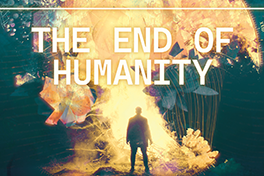
This documentary takes a critical look at our zeitgeist with its “algorithmic” view of humanity and asks for alternatives for a more humane future.
- Date: Tuesday, October 1, 2024, at 6:30 pm.
- Location: Kino Lichtspiel, Sandrainstrasse 3, 3007 Bern, CH
3rd Annual Emilie Jäger Lecture & Award Ceremony

Algorithms of Oppression: How Search Engines Reinforce Racism
The landscape of information is rapidly shifting as new imperatives and demands push to the fore increasing investment in digital technologies. Yet, critical information scholars continue to demonstrate how digital technology and its narratives are shaped by and infused with values that are not impartial. Technologies consist of a set of social practices, situated within the dynamics of race, gender, class, and politics, and in the service of something -- a position, a profit motive, a means to an end. In this talk, Dr. Safiya Umoja Noble discussed her book, Algorithms of Oppression, and delved into issues ranging from marginalization and misrepresentation in commercial information platforms like Google search, to the profound power struggles that violate civil, human, and collective rights through AI and machine learning projects. All portions of the event were held in English, but the lecture slides were also translated to German.
- Date: Friday, September 27, 2024, at 3.00 p.m.
- Location: 001 Hochschulzentrum, vonRoll, Fabrikstrasse 6
- Speaker: Professor Safiya Noble
NRP 77 Dialogue event ‘Digital readiness of the Swiss education system’

How can digital skills in the education sector be improved? What infrastructure is needed? What role do universities play in the digital transformation? Research findings from NRP 77 on digital readiness in education were presented and discussed at the dialogue event.
- Date: Tuesday, September 24, from 09.00 a.m. to 12.00 p.m.
- Location: Berner Generationenhaus, Raum: Bubenbergsaal 1 + 2, Bahnhofplatz 2, 3011 Bern
Digitized Research and Its Costs: Discussing Sustainable Development

How can large digital (research) infrastructures, such as the Alps supercomputer, be harmonised with sustainability goals? The keynote input by Prof. Jan Bieser (BFH) was followed by a lively discussion with invited experts from the Swiss research landscape. At the core of the discussion stood the examination of the social, ecological and economic costs of research and how these can be navigated with scientific goals. The event was organized by the Office for Sustainable Development and the Research Management Office under the auspices of the Vice-Rectorate Quality and Sustainable Development.
- Date: Wednesday, September 18, from 09:15 a.m. to 12 p.m.
- Location: Room 205, Hallerstrasse, Hallerstrasse 6, 3012 Bern
SUMMER COURSE 2024: LARGE LANGUAGE MODELS FOR BEHAVIORAL SCIENCE

An exciting program included expert keynotes, presentations by Ph.D. students, workshops, and many more. The summer course took place from June 26th to June 28th, 2024. Furthermore, for members of the Doctoral Program, there were several networking opportunities to connect and deepen the conversation about the topic.
- 3 ECTS
- Datum: Wednesday, the 26th of June to Friday, the 28th of June, 2024
- Ort: Unitobler, University of Bern
- Speakers: Dr. Dirk U. Wulf & Prof. Dr. Rui Mata
Mittelbau in digital transformation - develop, promote, network

Talks and Apéro
The focus group Forum Mittelbau promotes the digitalization-related interests of intermediate staff and evaluates applications from young researchers at the University of Bern to fund their own projects. Anyone interested is invited to attend to learn about currently funded projects, the new call for proposals, and opportunities for digitalization at the University.
Program:
- Introduction by the focus group Forum Mittelbau
- Welcome address by Prof. Dr. Christiane Tretter, Head of the Digitalization Commission DigiK
- Presentation of the Innovation Office: Sébastien Hug
- Presentation of the Digital Humanities: Prof. Dr. Tobias Hodel
Insights into projects
- Dr. Eva Kuske, Walter Benjamin Kolleg, Human vs. machine - manual and automated transcription, annotation and alignment
- Dr. Adrian Stefanov, Institute of Cell Biology, A digital organism - Paramecium
- Dr. Yvonne Schweizer, Institute for Art History, Interactive city model of the history of the Swiss Sculpture Exhibition in Biel/Bienne
APERÓ
Organisation: Dr. Michael Ackert, Dr. Dr. Ann Krispenz, Mirko Winkel
- Date: June 10th, 2024
- Time: 1:00 to 3:00 pm, open end
- Venue: UniS, room B-102
- Registration: LINK
Workshop: AI in the Central Administration II

On May 30, 2024, the participants of the second workshop "AI in the central area" together with Prof. Christian Matt from the Institute of Information Systems at the University of Bern (Prof. Jens Dibbern was unfortunately unable to attend due to illness) developed ideas for improving processes in the central administration.
Slides and further information can be found here.
SYNTHETIC DATA DAY
Synthetic patient data – these are AI-generated datasets that mimic the underlying real patient data so closely that the statistical properties of the original data are retained, but no personal information is available. Patient data "synthesized" in this way has the potential to solve a pressing problem in medical research. Namely, to make patient data widely available for research while fully and irreversibly protecting patient privacy.
What seemed like an insurmountable dilemma just a few years ago is now becoming a reality thanks to AI models. The Faculty of Medicine, the University of Bern and the Inselspital want to jointly explore the topic of "synthetic data" and lay the necessary foundations. The Synthetic Data Day, with presentations by national and international synthetic data experts, is the first step in this direction.
You can look forward to unique insights into the potential of synthetic data, its current areas of application, and the existing need for research.
Workshop: AI in the Central Administration
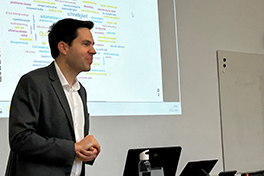
On February 29, 2024, the participants of the workshop "AI in the central area" together with Prof. Christian Matt from the Institute of Information Systems at the University of Bern (Prof. Jens Dibbern was unfortunately unable to attend due to illness) developed ideas for improving processes in the central administration.
Slides and further information can be found here.
AI@UniBE - Research in Dialogue

Be inspired by current applications of AI in research at UniBE and help shape the dialog on responsible AI!
Take part in the AI@UniBE - Research in Dialogue event at the University of Bern, where the current and future potential of AI in research will be presented. Learn about current research projects and approaches and take part in discussions about responsible AI in research. You will have the opportunity to interact with experts from various fields and share your ideas on shaping interdisciplinary AI research communities. Don't miss this unique opportunity to help shape and discuss the way forward!