Research Evaluation – University of Bern Units

The internal evaluation of research at the University of Bern supports strategic planning within faculties, institutes, and departments, while also contributing to quality improvement. In addition, it creates transparency and strengthens the University’s accountability to the public.
The University of Bern fully supports the movement to reform research evaluation and promotes a culture of responsible and fair research assessment. It has signed the San Francisco Declaration on Research Assessment, the Agreement on Reforming Research Assessment, and the Barcelona Declaration. It also coordinates the Better Science Initiative, which advocates for a diverse and equitable scientific culture.
UniBE process
Together with the Quality Assurance and Development (QAD) Office of the Vice-Rectorate Quality and Sustainable Development, the Vice-Rectorate Research and Innovation advises the Faculty Quality Committees on the design of the evaluation systems. It also provides research metrics and reports, and supports the Committees in interpreting the results.
Quantitative and qualitative evaluation
The University of Bern uses both quantitative and qualitative methods to evaluate institutional units. Internal evaluations based on quantitative indicators are not directly linked to resource allocation.
Quantitative data that are systematically collected include, among others, publication output, third-party funding income, fostering early-career researchers, knowledge and technology transfer, as well as national and international collaborations. These indicators support self-reflection within units and inform strategic discussions and monitoring.
Qualitative evaluations are generally conducted every eight years in the form of external peer reviews. These evaluations address strategic positioning, profile development, structural appropriateness, and the quality and impact of research activities. They are based on a broad set of indicators, including research focus areas, publication quality, collaboration networks, funding sources, contributions to teaching, services for the university, recognition through awards, and framework conditions for early-career researchers.
Indicators
Depending on the discipline, the methods used and the approach to publications can vary significantly. Therefore, the University of Bern selects evaluation indicators that are appropriate to the size and research field of the respective institutional unit, as well as to the purpose of the evaluation.
To take into account the specific characteristics of each discipline, the University of Bern actively involves the unit in the evaluation process and jointly develops the indicators and quality standards.
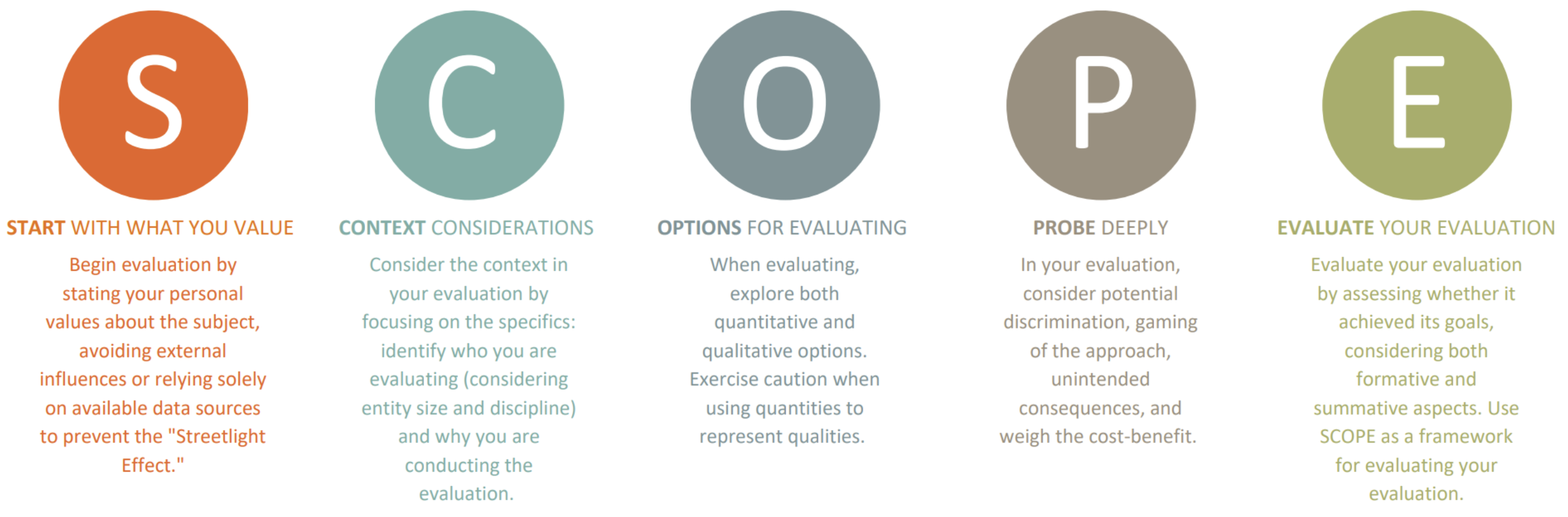
SCOPE Framework for Research Evaluation
In its evaluation process, the University of Bern follows the SCOPE Framework for Research Evaluation, developed by the Research Evaluation Group of the International Network of Research Management Societies (INORMS).
SCOPE is a five-step model for responsible evaluation and stands for: